What’s Her Story?
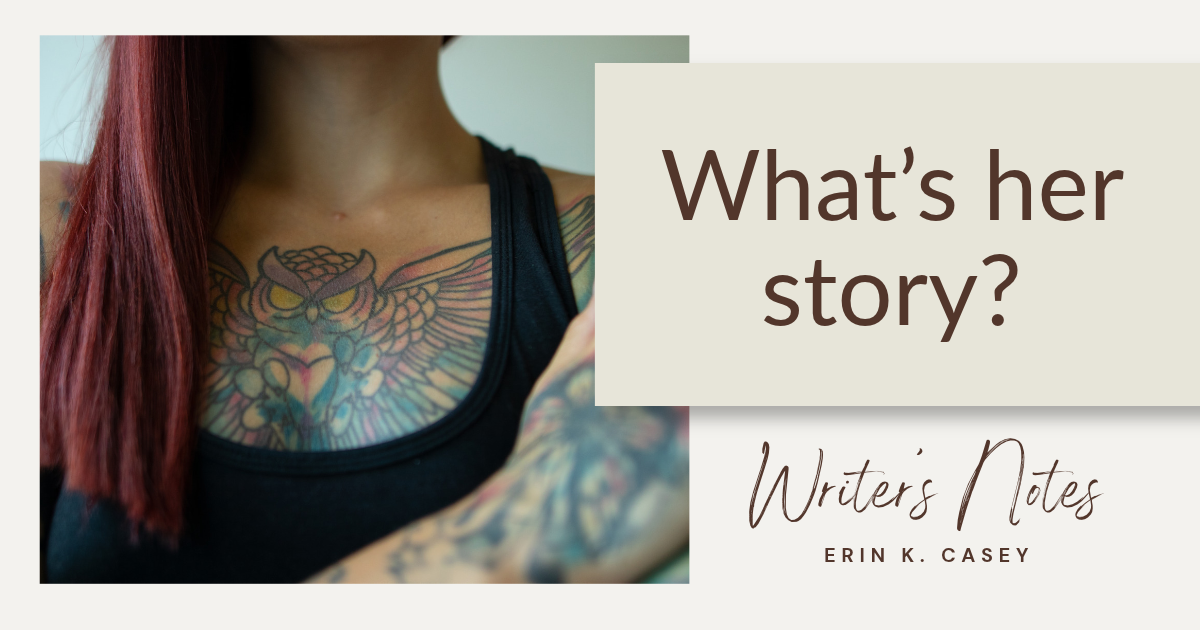
Tattoos covered the young woman’s face, her arms and neck—every visible part of her skin. Piercings on her ears, nose, lips, and eyebrows marked the intersection points for the lines on her face, like a colorful connect-the-dots pattern.
It was difficult not to form an immediate impression—to judge or think that I knew anything about her because of what I saw. But I know and love a lot of people with a lot of tattoos, and I’ve learned to question first impressions. Ink, to me, is a reminder that there’s often more to the story.
I offered a smile and said hello as I shimmied into the seat beside her.
No response. She either purposefully ignored me or, like most of the other passengers already seated, she was occupied by whatever was playing in her earbuds and couldn’t hear me. Either way, she didn’t seem open to conversation.
Not talking was fine with me. I’d had a headache all day. Packing for our trip and stressing about getting to the airport on time had only made it worse. All I wanted to do was sleep—to close my eyes and will the pain away.
But I’m not great at sleeping in public. And it became obvious she wasn’t feeling well. She shifted in her seat like someone who hurt all over.
Spirit and Sweat
One of the tattoos on the pale, crepey skin on her arm read “Spirit and Sweat.”
The words made me think of someone training for a triathlon—or battling cancer.
She broke the conversation barrier with effusive apologies for having to get up and go to the lavatory. Once she’d returned and we were settled back in our seats, she noticed that I was rubbing my head.
“Sinus headache?” she asked knowingly.
I nodded, pressing my fingers into my cheekbones. “All day.”
“I think I have some Excedrin Migraine, if you want me to dig it out of my bag.”
Declining, I listed all of the things I’d already taken that morning.
“I usually start the day with a combination of Excedrin Migraine and Aleve,” she said.
Asking why felt intrusive, so instead, I said, “After everything I’ve taken, I don’t think more medicine would help at this point. But thank you.”
We both went back to trying to rest until the flight attendants came around for drink orders.
After the young woman in the window seat asked for a soda, she said, “I want you to know that I have epilepsy. I’ve been feeling some symptoms. But if I have a seizure, it’s not an emergency.”
That didn’t seem right. Seizure and emergency go together in my book. The attendants’ wide eyes and follow-up questions let me know they felt the same way.
She continued with her explanation after they left. “I just wanted them to know so no one freaks out. People mean well and try to help, but then they call 9-1-1, and it’s a whole thing.” She shook her head and squeezed the large, plush green frog in her lap. “I’ve found that if I hold on to this, it keeps me from flailing if I have a seizure.” She sighed. “I’ve been dealing with this for a long time. Sorry in advance if I spill my drink on you.”
I had an overwhelming urge to hug her. To hold her. To will away the years of fear and weariness in her young eyes.
Instead, I put my hand on her arm. Spirit and sweat. “Is there anything I can do that’s helpful?”
Her eyebrows rose in surprise. “No, but thank you.”
She finished off her Coke and then snuggled down, squeezing the plushy.
My head still hurt, but the pain seemed less important. Eventually, that discomfort would subside. But this young woman had been dealing with seizures for who knows how long—and I wondered how much of her life was shaped by not knowing when another one would hit.
It had to be hard.
Spirit and sweat hard.
I sat there and silently prayed for her. It was the only thing I could do.
It was also the best thing I could do.
What do you see?
An hour or so later, when we got off the plane, she paused on the jet bridge and looked at me. “Thank you for caring.” Her expression and tone seemed to say, No one seems to care. Thank you for seeing me. For not judging me.
I smiled, and this time, she smiled in response.
I did see her. Through the ink and piercings, I saw a young woman who had spent too many years hurting. And still, I knew that what she had shared was only one page in a very long story.
It’s so easy to be distracted by appearances—to make assumptions and form judgments. And I believe that sometimes people put on masks because they want others to make those assumptions. Masks offer protection by deflecting or redirecting attention. If people judge me, I can write them off. I can protect myself.
But if we question our assumptions and suspend judgment, we might just discover that there’s more to notice:
More pain.
More depth.
More need for kindness.
And if we care enough to look beyond the masks and our own preconceptions, we’ll learn there’s almost always more to the story.
Whose story might God be inviting you to notice this week?